Reading Art
Algorithmic Reading: Toward an Artistic Practice of Reading
Can Reading Become an Art?
For centuries, literature has understood artistic creation primarily as the production of texts. The creative act has traditionally been associated with writing: the construction of sentences, narratives, poetic images, and linguistic structures.
This project explores a different possibility: that the design of forms of reading can become an autonomous artistic practice.
The central question is not only how texts are created, but how experiences of reading can be created. Reading ceases to be a secondary act of interpretation and becomes a creative space where trajectories, procedures, and perceptual structures can be designed.
From the Written Text to the Act of Reading
Various literary theories have recognized that the reader actively participates in the construction of meaning. The work does not exist solely within the text, but also within the encounter between written structure and the consciousness of the reader.
However, this research proposes a different question:
Can the very form of reading become a creative work?
The goal is not only to interpret an existing text, but to create procedures that transform the way that text is experienced.
Reading ceases to be merely a receptive action and becomes a compositional process.
Algorithmic Reading
Algorithmic Reading proposes the design of reading systems through rules, structures, and algorithms.
These systems can establish new relationships between the reader and the text through procedures such as:
Selecting words through numerical patterns.
Creating alternative pathways within a written work.
Establishing relationships between position, frequency, length, or linguistic structure.
Generating reading sequences determined by predefined rules.
The text remains as the original material, but the procedure transforms the experience of reading.
The algorithm does not necessarily create a new text; it creates a new way of accessing the text.
Reading as Creation
In traditional writing:
The author creates the text.
In Algorithmic Reading:
The creator designs a way of reading.
The artwork emerges within the relationship between:
Text + Rule + Reader
The reading procedure becomes an artistic tool capable of revealing new possibilities within an existing linguistic structure.
Creation is no longer located exclusively in the production of the textual object, but in the construction of the conditions through which that object can be experienced.
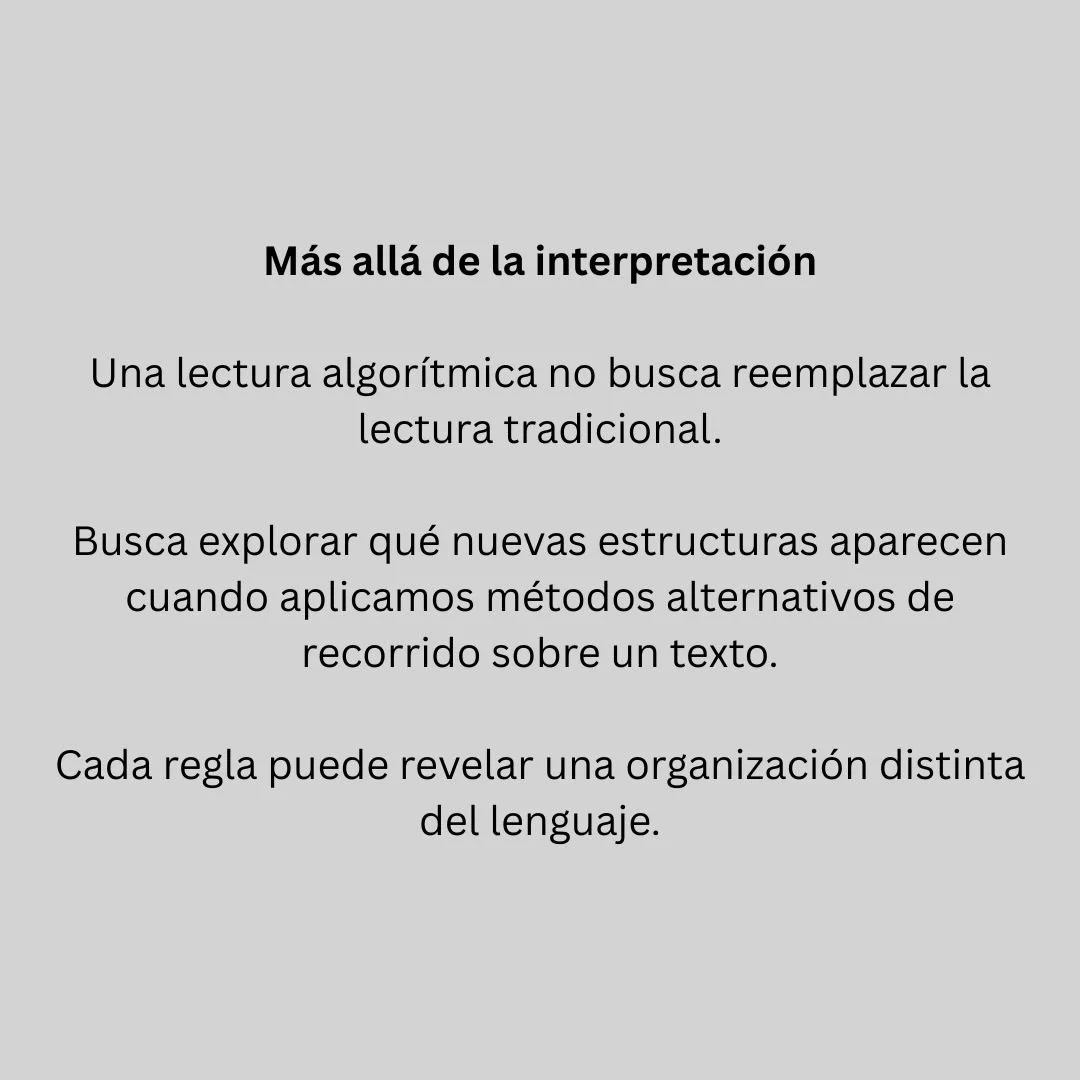
Beyond Interpretation
Algorithmic Reading does not seek to replace traditional reading or limit the reader’s freedom of interpretation.
Its purpose is to explore what new structures can emerge when alternative methods of navigating a text are applied.
Each rule functions as a tool of discovery. The same work can reveal different internal organizations depending on the system used to traverse it.
Reading thus becomes a form of exploration, composition, and discovery.
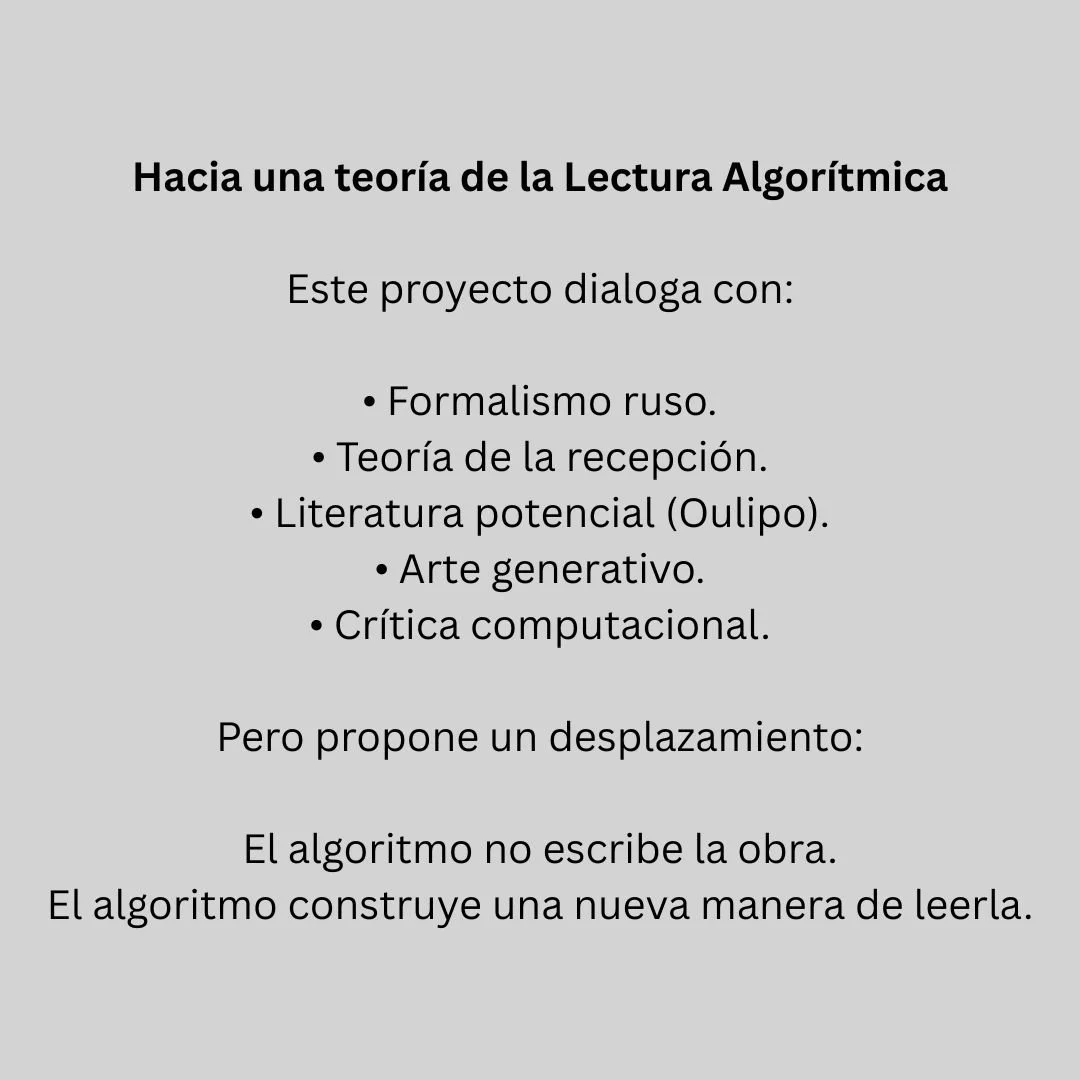
Toward a Theory of Algorithmic Reading
This project engages with various traditions and fields of research:
Russian Formalism.
Reader-response theory.
Oulipo and potential literature.
Generative art.
Computational criticism.
Studies of linguistic structures.
However, it proposes a conceptual shift:
The algorithm does not write the work.
The algorithm constructs a new way of reading it.
The focus moves away from the automatic generation of texts and toward the generation of reading experiences.
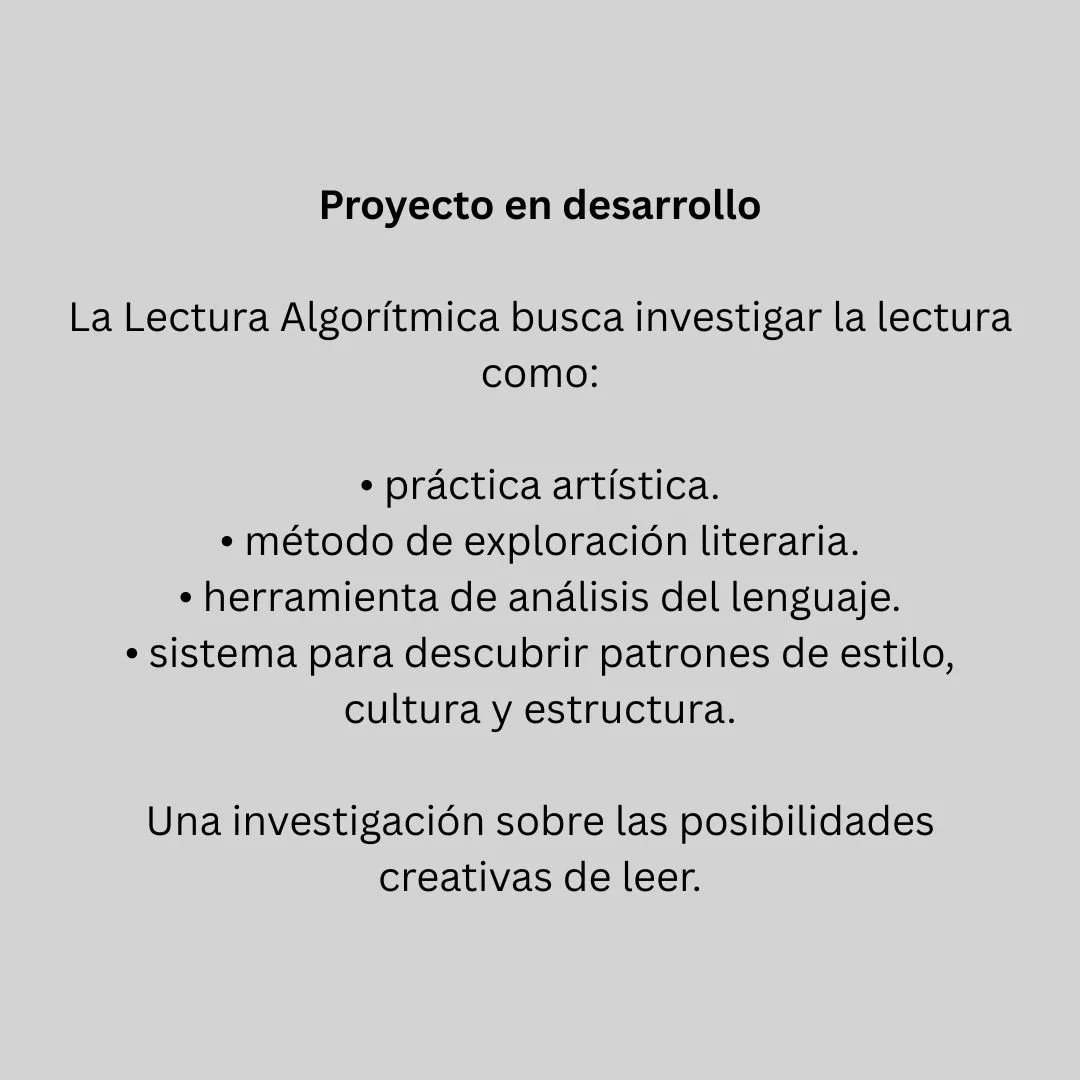
Project in Development
Algorithmic Reading seeks to investigate reading as:
An autonomous artistic practice.
A method of literary exploration.
A tool for analyzing language.
A system for discovering patterns of style, culture, and structure.
A form of composition based on procedures.
This research proposes understanding reading not as an activity that occurs after creation, but as a creative field in itself.
An investigation into the artistic possibilities of reading.
Spanish
Lectura Algorítmica: Hacia una práctica artística de la lectura
¿Puede la lectura convertirse en un arte?
Durante siglos, la literatura ha entendido la creación artística principalmente como la producción de textos. El acto creativo ha sido asociado tradicionalmente con la escritura: la construcción de frases, narrativas, imágenes poéticas y estructuras lingüísticas.
Este proyecto explora una posibilidad diferente: que el diseño de formas de lectura pueda convertirse en una práctica artística autónoma.
La pregunta central no es únicamente cómo se crean textos, sino cómo pueden crearse experiencias de lectura. La lectura deja de ser un acto secundario de interpretación y se convierte en un espacio creativo donde pueden diseñarse recorridos, procedimientos y estructuras perceptivas.
Del texto escrito al acto de leer
Diversas teorías literarias han reconocido que el lector participa activamente en la construcción del significado. La obra no existe únicamente en el texto, sino también en el encuentro entre la estructura escrita y la conciencia del lector.
Sin embargo, esta investigación plantea una pregunta diferente:
¿Puede la propia forma de leer convertirse en una obra creativa?
No se trata solamente de interpretar un texto existente, sino de crear procedimientos que modifiquen la manera en que ese texto es experimentado.
La lectura deja de ser únicamente una acción receptiva y se convierte en un proceso compositivo.
Lectura Algorítmica
La Lectura Algorítmica propone el diseño de sistemas de lectura mediante reglas, estructuras y algoritmos.
Estos sistemas pueden establecer nuevas relaciones entre el lector y el texto a través de procedimientos como:
Seleccionar palabras mediante patrones numéricos.
Crear recorridos alternativos dentro de una obra escrita.
Establecer relaciones entre posición, frecuencia, longitud o estructura lingüística.
Generar secuencias de lectura determinadas por reglas preestablecidas.
El texto permanece como materia original, pero el procedimiento transforma la experiencia de lectura.
El algoritmo no crea necesariamente un nuevo texto; crea una nueva forma de acceder al texto.
La lectura como creación
En la escritura tradicional:
El autor crea el texto.
En la Lectura Algorítmica:
El creador diseña una forma de leer.
La obra surge dentro de la relación entre:
Texto + Regla + Lector
El procedimiento de lectura se convierte en una herramienta artística capaz de revelar nuevas posibilidades dentro de una estructura lingüística existente.
La creación ya no se encuentra exclusivamente en la producción del objeto textual, sino en la construcción de las condiciones mediante las cuales ese objeto puede ser experimentado.
Más allá de la interpretación
La Lectura Algorítmica no busca reemplazar la lectura tradicional ni limitar la interpretación libre del lector.
Su propósito es explorar qué nuevas estructuras pueden aparecer cuando aplicamos métodos alternativos de recorrido sobre un texto.
Cada regla funciona como una herramienta de descubrimiento. Una misma obra puede revelar diferentes organizaciones internas dependiendo del sistema utilizado para recorrerla.
La lectura se convierte así en una forma de exploración, composición y descubrimiento.
Hacia una teoría de la Lectura Algorítmica
Este proyecto dialoga con diversas tradiciones y campos de investigación:
Formalismo ruso.
Teoría de la recepción.
Literatura potencial (Oulipo).
Arte generativo.
Crítica computacional.
Estudios sobre estructuras lingüísticas.
Sin embargo, propone un desplazamiento conceptual:
El algoritmo no escribe la obra.
El algoritmo construye una nueva manera de leerla.
La atención se desplaza desde la generación automática del texto hacia la generación de experiencias de lectura.
Proyecto en desarrollo
La Lectura Algorítmica busca investigar la lectura como:
Práctica artística autónoma.
Método de exploración literaria.
Herramienta de análisis del lenguaje.
Sistema para descubrir patrones de estilo, cultura y estructura.
Forma de composición basada en procedimientos.
Esta investigación propone entender la lectura no como una actividad posterior a la creación, sino como un campo creativo en sí mismo.
Una investigación sobre las posibilidades artísticas de leer.